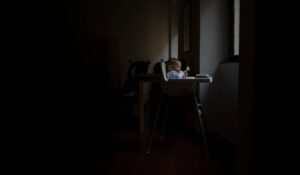
There is a particular kind of weight that comes with caring for a baby whose story you do not fully know.
Not because no one told you. But because the history that should exist, the birth record, the family context, the simple fact of who this child is and where they came from, arrives in fragments, carried by the dedicated professionals who brought them to our door. Babies who entered our home mid-chapter, whose beginnings we could only piece together from what was known at the time.
At Daybreak House we have sat with that incompleteness. It does not get easier. But it does deepen your gratitude for every person working within the child protection system, and your conviction that they need more support, more resources, and more partners alongside them.
The inequality hiding in plain sight
When a child from a middle-class suburb goes missing, the community response is immediate. Social media erupts. Neighbours organise. Support arrives from every direction.
When a baby is abandoned in an informal settlement, in a hospital bathroom, on a church step, the professionals who respond do so with enormous dedication, but often with far fewer community resources behind them. A social worker who is already giving everything adds another child to their file. The baby enters a system held together by people who care deeply and are being asked to do more than any system should ask of its people.
The inequality is not in the system’s intention. It is in the community support surrounding it.

What the Children’s Act promises
According to the Children’s Act, every child in South Africa has the right to family care, to protection from maltreatment, neglect and abuse, and to social services. These are not aspirational rights. They are constitutional guarantees.
The professionals working to uphold those guarantees, social workers, child protection officers, placement coordinators, do so with a commitment that deserves far more recognition and support than they typically receive. What they need, and what children need, is a stronger community standing alongside them.
That is where organisations like Daybreak House come in. And where you come in too.
What a Place of Safety actually does
Daybreak House is a registered Place of Safety, a term with specific legal meaning under the Children’s Act. We are authorised to receive children in need of care and protection and to provide emergency shelter and loving daily care for as long as each child remains in our home. The longer term planning for each child’s future is handled by the Department of Social Development and the social workers assigned to their cases. Our role is to make sure that while a child is with us, they are safe, healthy, and deeply cared for.
We do this work with love. We also do it with formula and nappies and electricity bills and staff who show up at midnight when a baby cannot stop crying.
We exist because the Department of Social Development and the professionals it supports cannot do this work alone, not because of any failure on their part, but because the need is simply that great. Places of Safety like ours are part of the solution the system was designed to include.
What the community can do
We are not a policy organisation. We are a home. But we have been close enough to the reality for long enough to say clearly: the most powerful thing a community can do is show up.
Show up as a donor. Show up as a volunteer. Show up as a company that sponsors a Place of Safety instead of buying branded golf shirts for a year-end function. Show up as a church that adopts a practical need instead of a symbolic one.
The social workers, placement officers and child protection professionals working within the system are doing their part. Daybreak House is doing ours. The gap that remains is the one that only a mobilised, generous, paying-attention community can fill.
Micah 6:8 asks us to act justly, love mercy, and walk humbly. Justice, in this context, looks like a community that sees every child, regardless of where they were born or to whom, and decides that seeing is not enough. That showing up is the only adequate response.
Until every child has what they need, places like Daybreak House will keep the light on. We hope you will help us do it.